Audio games shouldn't be dark
This February I took part in a game jam to make a game that is blind-accessible.
Audio games shouldn't be dark
Ours is, but not in that way
This February I took part in a game jam
I haven't done one before, and it was the premise of this one that pulled me in:
Make a game that is accessible to the blind and visually impaired.
The team I ended up connecting with was led by a veteran of the previous year's jam, whose concept managed to bring together what I think was an excellent team!
Delver's Folly was inspired by Blue Prince's room drafting mechanic, and the game features a version of that, as well as cool puzzles, and a gripping story. You must solve them in order to escape; you're trapped in a cave with a manticore, after all. I want to highlight a few things I personally learned during the jam from the experience of our team members, and from discussions in the jam's Discord community.
Quick hype to the team members
Joozey: Game design, programming, and UX. They brought tonnes of energy, vibrant ideas, and a rapid pace of development. I'm stunned at how much game emerged during just 30 days.
Sophie: SFX and audio implementation. Endlessly creative; and highly knowledgeable on the technical side of audio production and implementation.
Chad (aka UnsytedVoices): Our accessibility consultant and truly invaluable to the project. Has gone above and beyond with testing and feedback, and is a motivating and facilitating force in the group.
Jennissary & t0mm2: Character writing. Between them, their writing of the setting, narrative, and characters greatly shaped the direction of the game, and the soundtrack I wrote for it.
Brogan, Sam, Christian, Mia, & SightlessKombat: Our voice actors. I was blown away by their professional, clean performances, each of them bursting with their own character. Hearing them in the game really brings it to life.
Me: Soundtrack, artwork. I had great fun working with everybody, and I'm really happy with the way the soundtrack turned out!
Here's a few things I learned during this month:
Hey, what if our main character was blind
Don't do that. The first thing I learned about making a blind accessible game, is that you don't have to centre your game's theme and setting around the protagonist being, for whatever reason, unable to see.
In fact, it's quite heavily discouraged.
There's a long-running trope with audio games that they are set in the dark, or the main character is blind, or whatever. It's tempting to use that type of narrative framing to answer the question:
"Why is the information conveyed to the player primarily through audio?"
The thing is... why are you trying to answer that question? The game is an audio game, and therefore the information is conveyed through audio. There doesn't need to be more to it than that!
Our game is set in a cave, but we don't suggest that the protagonist is feeling their way around in the dark, because that's not the point of our story. Being unable to see isn't the danger; the monster that's gonna eat them is.
We convey information to the player primarily through text-to-speech (TTS) or their native screen reader. That brings me to the second thing I learned.
Support for screen readers in games can be quite difficult to implement, but it is worth it because it fits more naturally into a visually impaired user's preferred flow.
In our game, the TTS works reliably, but the screen reader has been a constant source of technical issues, and I applaud Joozey for navigating it with feedback from Chad.
It seems an impossible task to interfacing with a whole range of different screen readers, who may behave differently to one another, or depending on the user's personal settings. Testing with as many users and devices as possible is vital.
We don't just communicate things to the player that way though. This was already something I had in mind - secondary methods of communication that build connections more subconsciously. The obvious parts here are the sound effects, the doors you walk through, the sound of your footsteps, all the explicit sounds that tell you where you are and what you're doing.
But there are some more subtle things too: each of the directions, North, South, East, and West, have a unique sound that can be used to tell them apart. The reverb of your footsteps depends on which room you're in.
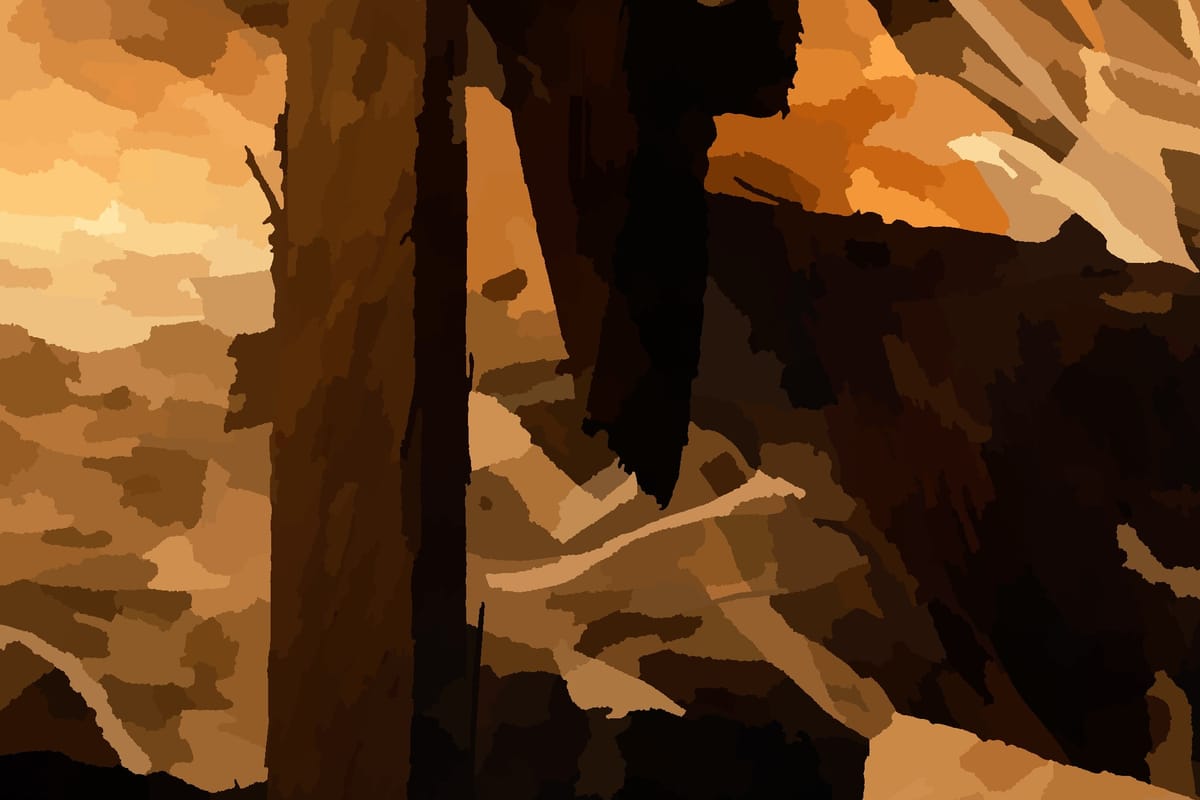
Another part of this are the background images we used for the rooms. A common misconception about the blind and visually impaired is that they can't see anything at all, but that isn't really true. Many have some amount of vision, even if that's just some perception of colours, or obstruction to some regions of their sight for example.
I edited some of my photographs to make abstract images, focusing on texture and colour. Some areas were shaggy and green, others glowed gold, and some burned red with danger. They aren't trying to be communicative beyond enhancing the vibe wherever they can.
Another thing I learned, which I suppose isn't really to do with accessibility directly, is that FMOD is really great. Being able to set up seamless transitions and loops and logic in the sound design team takes a burden off the programmer, and the software just works so well.
It's about folks, not features
More than anything else though, I learned that you can't make a game accessible without talking to and testing with the people you want it to be accessible to.
Fundamentally, as sighted people, we will never be able to fully understand the needs and experiences of a visually impaired player without asking them. Accessibility isn't just adding screen reader support or remappable keys, it's establishing connections to people who would otherwise be poorly served by this industry, and including them in this joyful hobby.
Oh hey, shout out to Games for Blind Gamers! Everybody's entries are up and ready for voting. Of course, I think Delver's Folly is wonderful, but there has been so much creativity and achievement from all the other teams that I urge you to try as many out as you can!
As part of the event, I matched the prize pool in a donation to these three charities, and you should support them too!
A vote in the jam's discord server distributed the donation as $100 to Guide Dogs and $50 each to RNIB and SpecialEffect.